Lotus Festival 2026
Írta: Daryana Antipova | 2026. 10. 15.
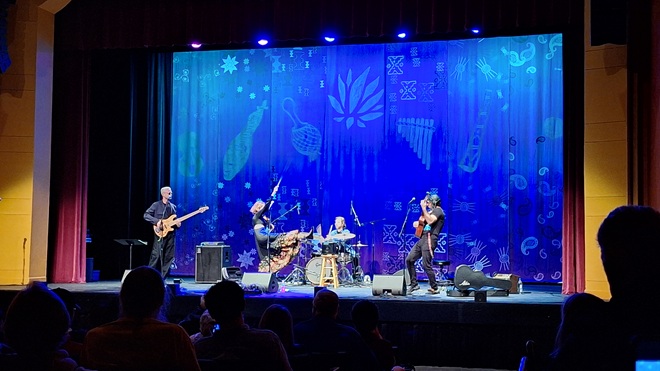
The 33rd annual Lotus World Music & Arts Festival, held October 1–4 in Bloomington, Indiana, showed that even a well-established festival can find new ways to grow. This year, Lotus introduced new spaces, expanded its community activities, and brought more attention to local artists and cultural traditions. The result was a lively weekend that brought music and art into the heart of downtown Bloomington.
One of the most noticeable changes was the organization of the festival itself. The program felt more structured, with different activities having their own spaces and purposes. There was also a sense of fresh energy behind the event, as if new people and new ideas had become part of the organizing team.
An important addition this year was Conversations in Bloom: A Symposium on Arts, Community, and Memory, held on September 30 and October 1, just before the main festival program began.
The two-day symposium brought together artists, cultural organizers, researchers, and community members to discuss the future of the arts in Bloomington. Sessions took place at the I Fell Building, FAR Center for Contemporary Arts, and Lotus Firebay.
The discussions covered topics such as preserving cultural memory, creating spaces for artists, cooperation between generations, and the role of traditional arts in modern communities. On Thursday, October 1, the program included a conversation between Myaamia artist Dani Tippmann and Traditional Arts Indiana director Jon Kay about keeping traditional arts alive. The afternoon ended with a keynote discussion featuring Michael Orlove from the National Endowment for the Arts and John Fenn III from the American Folklife Center, moderated by Lotus co-founder James Combs.
The festival officially opened that evening with a concert at the Buskirk-Chumley Theater. Adding a professional symposium to the festival program was an interesting step, connecting live performances with wider conversations about culture and the future of local arts communities.
Another successful new feature was the Arts Village, located on a closed section of Kirkwood Avenue near the Monroe County Courthouse. It offered art activities, demonstrations, and opportunities for visitors of different ages to take part in the festival beyond simply attending concerts.
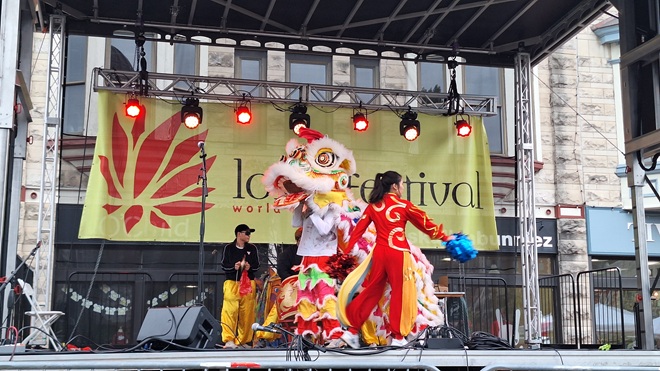
On Friday evening, Traditional Arts Indiana presented a three-hour program that began with remarks by professor Jon Kay. One of the memorable moments was a colorful Chinese dragon performance accompanied by traditional drums, featuring Leung Ching Ka and Jacob Kopis from Marion County.
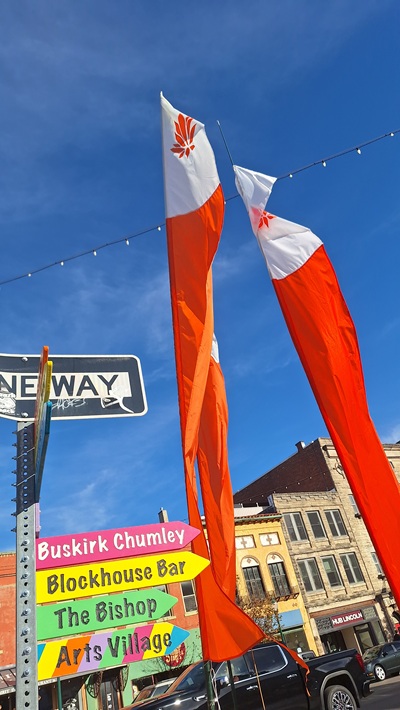 The Arts Village was a welcoming place for families, although the program for children could have been more extensive. Still, it gave the festival another important dimension and made traditional arts more visible to the public.
Of course, music remained the main attraction. The international lineup offered a wide range of styles and traditions. Among the most impressive performances were Bohola from Ireland, whose incredible energy and musicianship made a strong impression, Gadan from Italy, and Chicago-based Fugu Dugu.
Moving between different venues was part of the experience. Within a single evening, visitors could discover completely different musical traditions, meet friends in the streets, and enjoy the atmosphere of a city transformed by music.
The return of the 6th Street Tent, supported by donors, was another welcome change. Performances by Insun Park & Generals, Nour Harkati, and El Laberinto del Coco brought large, enthusiastic audiences together.
Festival volunteer Teri Watkins described this year's new format as “one of the most engaging and community-focused experiences in recent memory.” She especially appreciated seeing people dancing together in the streets again, something that had been missing from recent editions of the festival.
For some visitors, Lotus was also a family discovery. One mother, who brought both of her children for the first time, said that watching her music-loving child become fascinated by live performances gave her a completely new understanding of the festival. It was not only about hearing great musicians, but also about seeing a young person discover the power of live music.
Not every change worked perfectly. Some visitors were confused about the starting point of the festival parade, and the family program still has room to grow. But the overall impression was positive.
With beautiful autumn weather, a strong international lineup, new opportunities for local artists, and a more clearly organized program, Lotus 2026 felt both familiar and renewed.
Perhaps the most important achievement was that the festival continued to bring together people who might otherwise never meet. I finally met Ilya Sokolov who we’ve been ‘FB friends” foe some time, and I just realized during the Fugu Dugu performance, that he actually can be there as their new manager, so I managed to invite Fugu Dugu musician for the interview next early Saturday morning to WFHB studio to talk about their new album Bucky Wanko and The Legend of Baba Yaga.
For four days, downtown Bloomington once again turned into a place where music, traditions, and communities from different parts of the world could meet.