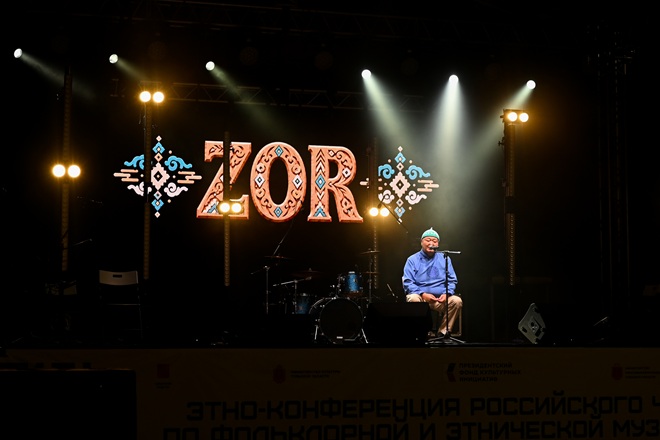
Four days of music, unlikely collaborations, and a three-hour midnight jam in Tula
Írta: Daryana Antipova | 2026. 10. 06.

Put a traditional singer from Belgorod, a Karelian multi-instrumentalist, a Belarusian folk band, an electronic musician, a Serbian folklorist and a gusli player in the same place for four days. Add festival directors, journalists, radio programmers and international music professionals, but leave enough space for people to talk, rehearse, argue, improvise, create friendship and stay up playing together long after the official program has ended.
This was essentially the experiment behind the 2nd International Ethno Conference of the Russian World Music Chart, held in Tula, Russia, from September 23 to 26.
Officially, it was a conference. In practice, it increasingly felt like a short-term artist residency. The first edition took place in 2023. Even then, we were never particularly interested in reproducing the standard music-conference model: panels, business cards, showcases, goodbye. We wanted musicians to have time. Time to stay in the same environment with other people working with traditional culture. Time to play. Time to discover that the musician sitting across the table at breakfast might become a collaborator by the end of the day. In that sense, the conference was conceived less as a conventional industry event and more as a temporary creative community, a four-day artist residency hidden inside a music conference.
Conference director Irina Brykova and I are both performing musicians. We know the industry not only through organizing the Russian World Music Chart, but from the other side of the stage. “Daryana and I are musicians ourselves, so from the very beginning we understood the challenges artists face when trying to develop their bands,” Brykova says. “We know how difficult it is to promote yourself, make a living from music, and how important it is for every artist to have their work heard and appreciated. Every musician needs an audience and applause.”
So this year the residency idea was surrounded by a much larger professional program. Instead of broad conversations about “international promotion,” we tried to discuss actual markets, actual touring routes and actual people musicians might encounter there.
Adèle Man-Ching of Stallion Era Beijing spoke about China. Brazilian journalist and Mundo Sonoro radio host Janaína Ávila discussed Latin America. Alejandro Riotte, director of Costa Rica’s URÀ showcase festival, introduced the music industry of Central America and the Caribbean. Tatiana Naryshkina focused on something even more specific: the realities of organizing tours in the Balkans. Her role also showed how the project itself has developed.
“In 2023, I came to Tula with VEDAN KOLOD as a musician and gave a lecture about promoting a band,” she says. “This time, I spoke about the practical side of organizing tours in the Balkans, based on my own experience. The conference is growing before our eyes and becoming more and more interesting.”
Festival organizers, radio programmers, journalists and labels joined the conversations. The idea was to let musicians meet the very people who normally receive their applications, press releases and recordings. One of those conversations even produced a formal result. Ethno-MY, the nonprofit organization behind the conference, signed a cooperation agreement with the Research Center for Traditional Culture and Art of the National Academy of Sciences of Kyrgyzstan, headed by singer and ethnomusicologist Roza Amanova. The agreement includes joint projects and possibilities for Russian artists to participate in festivals in Kyrgyzstan.
For four days, musicians worked in creative laboratories at several locations around Tula. The goal was potentially uncomfortable: play with somebody you would not normally play with. The combinations were deliberately not always obvious. Some participants work with traditional material in an almost ethnographic way. Others use electronics, rock, contemporary songwriting, rare traditional instruments or experimental forms. This created real disagreements. Some musicians working with authentic folklore were reluctant to “spoil” the original material by adding guitars or electronics. Others were excited by exactly that possibility.
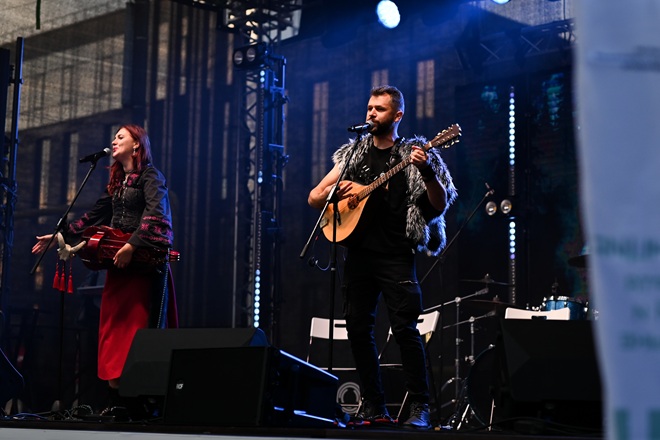
An artist residency does not have to manufacture instant harmony. Sometimes it simply creates a safe place for people with different ideas to discover whether they have a musical language in common. The Belarusian band Aratseya, for example, found itself working with RusTradEns and Serbian-Russian musician Miloš Lovčenski. Together they recorded a jam based on a traditional Belarusian harvest song. After returning to Minsk, the band wrote:
“It is very important for us to be part of this and to keep our communication and friendship alive. Now we are back home in Belarus and starting serious work on new tracks and collaborations. But we are sure that we will see each other again very soon.”
For me, there was another, more personal circle closing in Tula. Among the musicians we invited were Vladislav Demin and percussionist Andrey Mikhailov. We first met 22 years ago at Kamwa — the first major festival of my own musical life. Now we found ourselves together again, in completely different roles.
On September 26, the conference culminated in a four-hour gala concert at the Oktava Creative Industrial Cluster, bringing more than 20 musical projects onto one stage.
Mikhailov listened to the whole thing. “The organizers created an amazing musical mosaic, mixing different styles and forms of ethnic music: from traditional folklore and experimental formats to folktronica and indie pop,” he said afterward. “We also added our own color to this large musical picture.”
Other musicians described the aftermath less in terms of genres.
Alexander Medvedev, who came from Khakassia, wrote: “I feel like I now have friends in every city!”
Zemfira Rashitova from Bashkortostan hoped that the energy of the conference would produce “a lot of new music.”
And Vladimir Guskov of Lestvitsa described the four days as being united by “one big heart” and a deep love for folklore.
An informal folk gathering began in the conference hall and gradually turned into a spontaneous jam session. There were no assigned groups anymore. No stage. The musicians simply started playing. And they continued for almost three hours.
“Everyone listened to each other and experimented,” Brykova recalls. “You could hear musical traditions from the Belgorod region blending with Karelian instruments, Miloš playing the Bulgarian bagpipe, and Dmitry Paramonov playing the gusli. Sometimes the musicians had to step outside their comfort zones, but at the same time they truly felt that they were part of their own musical community.”
The Russian World Music Chart was created in 2021 to help new Russian folk and ethnic releases reach professional listeners internationally. The conference has gradually become the physical side of the same idea: connecting the people who make this music with those who record it, release it, write about it, play it on the radio and book it for festivals.