Tanztheater Wuppertal Pina Bausch: Vollmond – Müpa, 2026. április 12.
Írta: Hana Yamazaki | 2026. 04. 18.
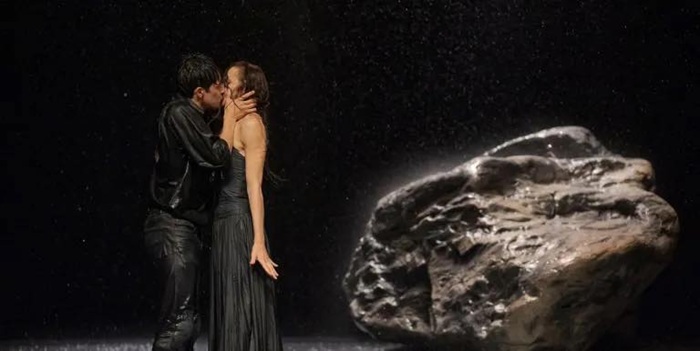
Pina Bausch’s Vollmond, even after her death in 2009, continues to evoke an intricate web of emotions that feels strikingly alive and deeply relevant.
Bausch once described the most important lesson from her early dance education as the need to be “honest and precise” in artistic expression. The more one reflects on her work, the more these two qualities seem to define her choreographic language. In Vollmond, she explores relationships between adults—men and women who appear adrift, caught between desire, despair, and pleasure.
Conventional rules are repeatedly disrupted: wine glasses overflow, a playful bra-untying competition unfolds, and a woman pours lemon juice over herself while holding a knife. Each character seems compelled to act on emotion with full physical intensity. At times they struggle with vigor, at others with grace or humor, but always with a palpable urgency.
These passionate interactions take place within a striking natural landscape. A massive meteorite-like rock dominates the stage, resembling an island. Behind it flows knee-deep water, like a quiet stream, while rain falls intermittently—from gentle drizzle to heavy storm. The setting feels elemental and raw, yet it is juxtaposed with the performers: women in long, sensual, colorful dresses and high heels, delicately holding wine glasses. The contrast is at once poetic and subtly comic.
Bausch’s process was rooted in a deep understanding of her dancers. Known for asking thousands of questions, she cultivated uniquely personal relationships with each performer, as she described in her 2007 Kyoto Prize speech. This intimacy is evident throughout the piece.
In the first half, Tsai-Chin Yu’s solo, dressed in white, radiates strength and beauty, set to the jazzy rhythm of Jun Miyake’s Lilies of the Valley. Her declaration—“I am young! My ears hear promise. My mind is power. My eyes see dreams!”—extends her energy beyond movement into voice.
In contrast, Julie Anne Stanzak, one of the original cast members, delivers a powerful solo in the second half. Dressed in black, she is drenched as other dancers hurl buckets of water against the rock, creating a visually spectacular moment leading toward the finale.
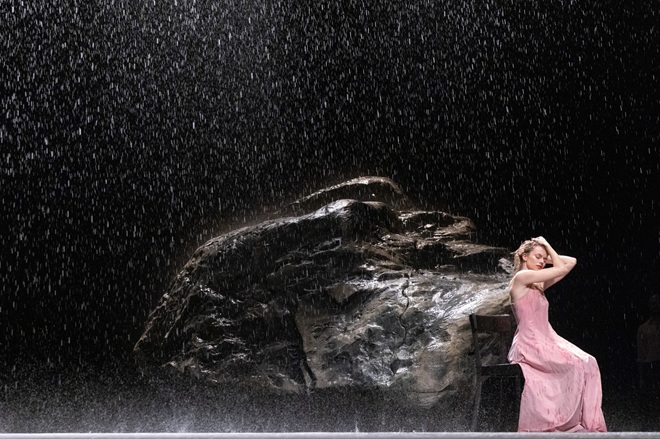
Water is the central element of Vollmond. It transforms the dancers, making them fluid and seemingly inseparable from nature. Wet and unrestrained, they splash and play with a childlike spontaneity, as if discovering a fountain for the first time. Yet beneath this freedom lies remarkable precision. Each solo carries a distinct atmosphere, executed with technical mastery while retaining individuality and humanity.
Bausch’s meticulous attention to her dancers lies at the heart of her choreography. It is no coincidence that her company embraces diversity—not only in nationality and physicality, but also in age. These differences are not merely included; they are celebrated as essential to the work.
The musical landscape is equally diverse, ranging from Tom Waits to the rich instrumentals of René Aubry, the experimental jazz of Jun Miyake, and even the jazz-hip-hop fusion of Cujo’s Fat Ass Joint. This eclectic mix enhances the work’s dynamic texture.
A particularly thoughtful touch was the inclusion of narrated sections translated and spoken in Hungarian. As a foreigner living in Hungary, I recognize the difficulty of this gesture, and it was clearly appreciated by the audience at Müpa. This commitment to engaging with cultural diversity reflects the enduring spirit of Pina Bausch’s legacy.
“Kicsit savanyúkás vagyok” (I’m a little bitter), says Taylor Drury, covered in lemon juice.
Vollmond remains a profoundly beautiful work, performed with depth and vitality by Tanztheater Wuppertal.